





AI can turn an idea into a polished interface in minutes. But making something look ready isn't the same as knowing it's worth building.
AI-assisted design has changed how quickly I can explore ideas.
What once required hours of wireframing, designing and prototyping can sometimes take shape in minutes. I can generate layouts, explore interactions and turn early concepts into something tangible much faster.
That's genuinely useful.
But faster execution raises a question I think product designers should take seriously:
Are we getting better at solving problems, or simply faster at designing solutions?
A polished interface can hide an unresolved problem
Imagine we're designing a task management application.
The initial brief is simple: help people manage their work more effectively.
An AI tool could quickly generate a beautiful dashboard with prioritized tasks, progress indicators and intelligent recommendations.
It might look convincing enough to present to stakeholders.
But we've already made an important assumption: that people struggle because they don't know what to work on next.
What if that's not the problem?
What if they know their priorities but have too much work? Or they're unable to move forward because they're waiting on someone else?
All three situations might look like a productivity problem, but they require different solutions.
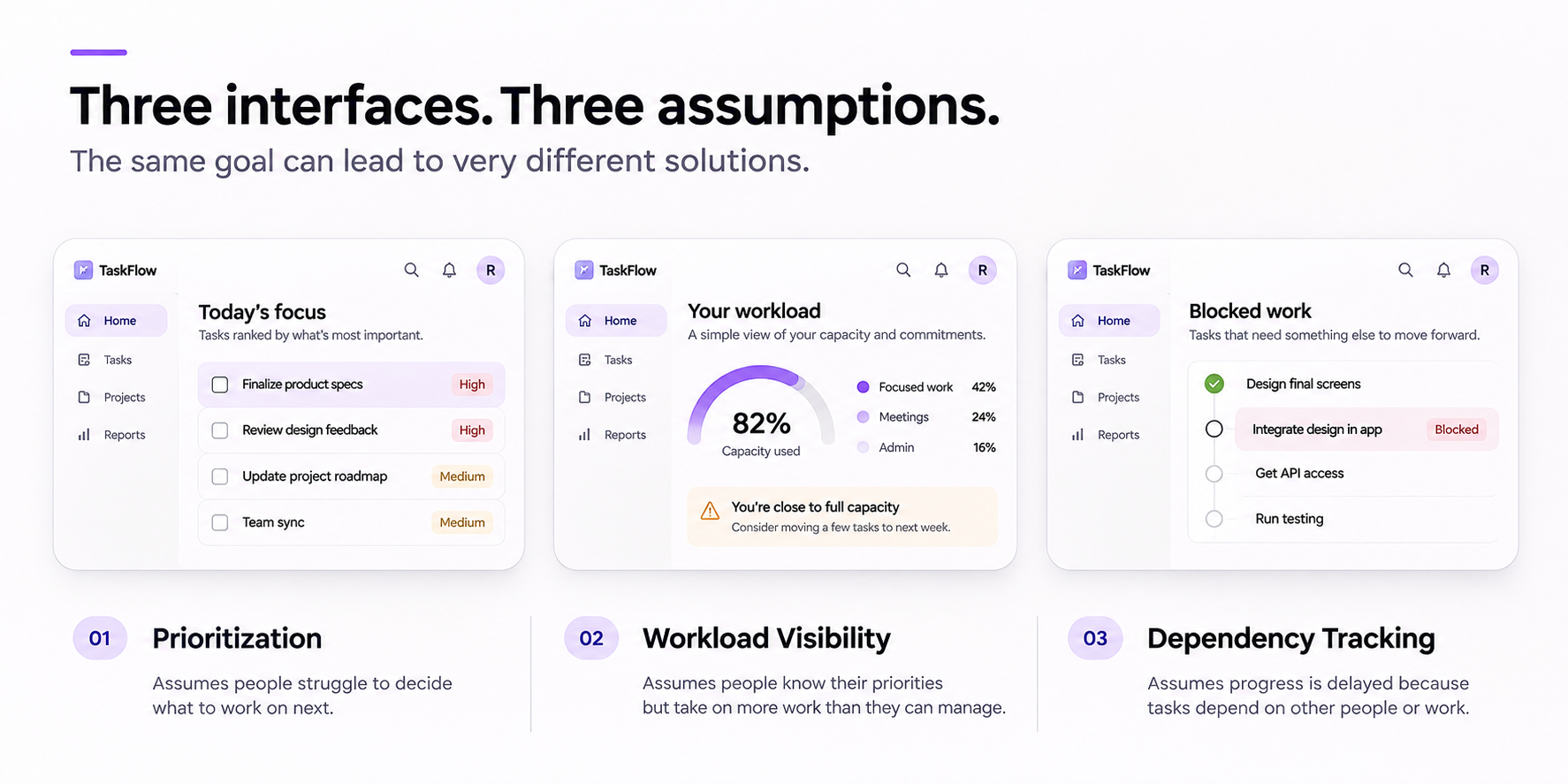
Three interfaces. Three assumptions. One unresolved problem.
To illustrate this, I explored three conceptual directions for a fictional task management product called TaskFlow.
AI Prioritization
An interface that ranks tasks and recommends what to work on next.
Assumption: Users struggle to identify their most important tasks.
Workload Visibility
A dashboard showing capacity, commitments and potential overwork.
Assumption: Users understand their priorities but consistently take on more work than they can manage.
Dependency Tracking
A view highlighting blocked tasks, dependencies and outstanding actions.
Assumption: Progress is delayed because users depend on other people or unfinished work.
Each interface could be visually polished. Each could be technically functional.
But they represent three different interpretations of the problem.
And without understanding the people we're designing for, we don't know which interpretation deserves our attention.
These concepts are illustrative, not validated research findings. Their purpose is to show how different assumptions influence design decisions.
Faster execution should create more opportunities to learn
I don't think designers should resist AI-generated interfaces.
If anything, I see them as an opportunity to investigate ideas earlier.
Instead of spending days producing one direction, we can explore alternatives, identify constraints and make assumptions tangible.
But generating more options isn't necessarily progress.
The value comes from what we do with those options.
Do we speak to users? Examine existing workflows? Challenge our assumptions? Test whether the proposed interaction addresses the problem?
A prototype can help us investigate these questions.
It cannot answer all of them simply by existing.
Three questions I use to evaluate a product direction
When exploring AI-assisted concepts, I find it useful to separate three questions.
Can we build it? — Feasibility
Is the solution technically possible, accessible and practical within the available constraints?
Should we build it? — Value
Does it address a meaningful user need? What evidence supports that belief? Is there a simpler alternative?
How will we know it worked? — Evidence
What outcome should improve? How will we evaluate it? What would make us reconsider the decision?
These aren't rigid sequential steps. They inform one another throughout the design process.
And AI can contribute to all three.
It can help explore feasibility, generate hypotheses and organize research. But its recommendations still need to be examined against reliable evidence.
The same applies to our own intuition.
Product judgment is more than choosing the best-looking solution
I don't believe the future of product design is simply humans doing strategy while AI handles execution.
AI is already useful in parts of strategic work, and those capabilities will continue to evolve.
What matters is how responsibly we use them.
For the TaskFlow example, the next step wouldn't be selecting the most attractive dashboard.
It would be investigating whether prioritization, workload or dependencies are meaningful problems for the intended users.
We might discover that one direction deserves further exploration.
We might discover that none of them addresses the real issue.
Either outcome would help us make a better-informed decision.
And that's where I believe experienced product designers continue to bring substantial value: not because they always know the right answer, but because they understand how to question an answer before committing to it.
The real advantage isn't speed alone
AI is making it easier to turn ideas into interfaces. I see that as an opportunity, not a threat.
But I don't want faster production to become our definition of better design.
A beautiful interface can still solve the wrong problem. A working prototype can still be built around an unsupported assumption.
The goal isn't to produce the most screens or reach development as quickly as possible.
It's to reduce uncertainty, make thoughtful trade-offs and create something genuinely useful.
Because being able to build an interface is one thing. Knowing why it should exist is another.